Carbon Capitalism: Energy, Social Reproduction and World Order by Di Muzio Tim
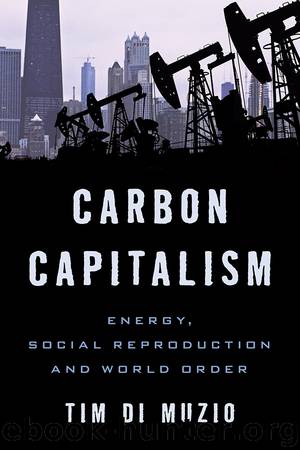
Author:Di Muzio, Tim [Muzio, Tim Di]
Language: eng
Format: epub
Publisher: National Book Network International
5
Global Carbon Capitalism
It should be clear from our analysis so far that the construction of a highly uneven and hierarchical petro-market civilization on a global scale was never dislocated from the apparatuses of force and the near-continual application of violence based on constant technological innovation in the leading belligerent states. As Luxemburg pointed out long ago, ‘[F]orce is the only solution open to capital: the accumulation of capital, seen as a historical process, employs force as permanent weapon, not only at its genesis but further down to the present day’ (Luxemburg 1913, 371). As carbon capitalism became more institutionalized and organized, this was always the result of a fusion of state fiscal and growing corporate power. Where greater energy could be harnessed, more elaborate apparatuses of violence could be constructed and more domination over populations and resources could be applied against resistance internationally. In this sense, thinking of a ‘state’ sphere and a separate ‘economic’ sphere appears very odd in the light of history, where we find them everywhere inextricably interwoven.
I have also tried to show how these developments have chiefly benefited dominant owners, or what we are now calling the 1 percent (Di Muzio 2015a). This is not to say that benefits were not gained by the lower classes as carbon capitalism developed. Surely it cannot be denied that in certain parts of the world ‘living standards’ and opportunities and life chances were enhanced for a considerable size of the global population with access to greater energy flows and stores. But whatever these achievements, particularly in the global north, we can argue that they must be viewed as the result of struggles for recognition and rights within the historical context of rising energy use and greater global militarization (Mitchell 2011; Nikiforuk 2012). In addition, we could make the reasonable claim that these developments should also be understood within an ongoing intraclass and interclass war for differential accumulation on a far more global scale than was possible only centuries ago. This is not to deny the poor, working class, or disenfranchised masses of the world their agency. Dominant owners have always come up against opposition and resistance to the exercise of their will to power over others and the control of the natural world (Foucault 1982; Gill 2008). But the chief difference between the 1 percent and the rest is this: their wills are almost always backed by decisive violent and institutional force and these forces are, more often than not, the result of uneven access to energy, money and political power.
Where we find hierarchies of power and privilege and extreme divisions of social wealth appropriated by the few, we can be sure to find hierarchical forms of agency and justifications for this hierarchy. Whatever the weapons of the weak, it is simply not true to say that workers or nonowners of society’s income-generating assets have the same access to resources, political power and weaponry as their masters. Even where there is a semblance of civil peace, we
Download
This site does not store any files on its server. We only index and link to content provided by other sites. Please contact the content providers to delete copyright contents if any and email us, we'll remove relevant links or contents immediately.
International Integration of the Brazilian Economy by Elias C. Grivoyannis(111326)
The Radium Girls by Kate Moore(12098)
Turbulence by E. J. Noyes(8133)
Nudge - Improving Decisions about Health, Wealth, and Happiness by Thaler Sunstein(7765)
The Black Swan by Nassim Nicholas Taleb(7202)
Rich Dad Poor Dad by Robert T. Kiyosaki(6737)
Pioneering Portfolio Management by David F. Swensen(6345)
Man-made Catastrophes and Risk Information Concealment by Dmitry Chernov & Didier Sornette(6145)
Zero to One by Peter Thiel(5876)
Secrecy World by Jake Bernstein(4807)
Millionaire: The Philanderer, Gambler, and Duelist Who Invented Modern Finance by Janet Gleeson(4541)
The Age of Surveillance Capitalism by Shoshana Zuboff(4362)
Skin in the Game by Nassim Nicholas Taleb(4312)
The Money Culture by Michael Lewis(4269)
Bullshit Jobs by David Graeber(4256)
Skin in the Game: Hidden Asymmetries in Daily Life by Nassim Nicholas Taleb(4057)
The Dhandho Investor by Mohnish Pabrai(3829)
The Wisdom of Finance by Mihir Desai(3799)
Blockchain Basics by Daniel Drescher(3644)
